Anatomy of Distal Interphalangeal Joint

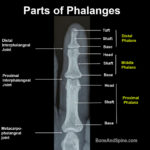
Distal interphalangeal joint is the joint between distal phalanx and middle phalan.

Distal interphalangeal joint is a bicondylar ginglymus joint.

The joint is very well stabilized collateral ligaments on medial and lateral side and the volar plate

There are two types of collateral ligaments -

distal-interphalangeal-joint

- The proper collateral ligaments which  insert on the lateral tubercles at the base of distal phalanx.

- The accessory collateral ligaments attach distally to the lateral margins of the volar plate.Distal interphalangeal joint stability is maintained by articular congruity, the dynamic balance of flexor and extensor tendons and  ligaments.


Volar Plate

The term volar plate can be used for a plate fixed on volar aspect of bone but in this article we discuss an anatomical structure.

Volar plate in the hand [also referred to as palmar or volar ligaments] are fibrocartilaginous structures found in the metacarpophalangeal and interphalangeal joints.

Their main function is reinforcement of the joint capsules, increase in joint stability, and limitation of hyperextension.

volar-plateThis fibrocartilaginous structure is attached to the base of the proximal phalanx distal to the joint. From there, it forms a palmar continuation of the articular surface of the phalanx bone and its inner surface thus adds to the articular surface during extension.

In its proximal end, the volar plate becomes membranous and blends with the volar capsule which is attached to the head of the metacarpal bone.

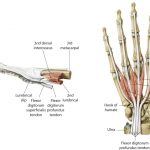
The volar plate of the distal interphalangeal joint has a proximal attachment weakly confluent with the distal extent of the flexor digitorum superficialis tendon

During flexion, the plate glides proximally down the volar surface of the metacarpal head. Its flexible attachment to the phalanx bone not only prevents it from restricting joint movements, but also prevents the long flexor tendons from being pinched in the joint.

Text adapted from Wikipedia

Anatomy of The Nail Bed of Fingernails

The nail, an integral component of the digital tip serves to protect the fingertip, provides counterforce to tactile sensation  and carries thermoregulationion via glomus bodies in the nail bed and matrix.

Parts of The Nail

Nail Plate

The nail plate (corpus unguis) is the hard visible part of the nail.   The nail plate is composed of hard, keratinized, squamous cells that are loosely adherent to germinal matrix but strongly attached to the sterile matrix.

Matrix

Matrix is the tissue that a nail [nail plate] protects. It lies beneath the nail and contains nerves, lymph and blood vessels. The matrix is responsible for producing cells that become the nail plate. It has two parts strile and germinal.

Lunula

Lunula represents distal extent of the germinal matrix.

Hyponychium, Eponychium and Paronychium

The hyponychium is the epithelium located beneath the nail plate at the junction between the free edge of the nail and the skin of the fingertip.

The eponychium is the small band of epithelium that extends from the posterior nail wall onto the base of the nail.

Paronychium are the lateral nail folds on either side of nail plate.


Antatomy  of Nail


Blood Supply

The arterial blood supply to the perionychium originates from the terminal branches of the radial and ulnar proper palmar (volar) digital arteries.


Anatomy of The Nail

The nail is an integral component of the digital tip serves to protect the fingertip, provides counterforce to tactile sensation  and carries thermoregulationion via glomus bodies in the nail bed and matrix.

Parts of The Nail

Nail Plate

The nail plate (corpus unguis) is the hard visible part of the nail.   The nail plate is composed of hard, keratinized, squamous cells that are loosely adherent to germinal matrix but strongly attached to the sterile matrix.

Matrix

Matrix is the tissue that a nail [nail plate] protects. It lies beneath the nail and contains nerves, lymph and blood vessels. The matrix is responsible for producing cells that become the nail plate. It has two parts strile and germinal. [Read more...]

Anatomy of Distal Phalanx of Hand

The distal phalanx consists of following parts, from proximal to distal.

  • Base
  • Shaft
  • Tuft or ungual tuberosity

These phalanges differ in size, shape and contour from proximal and middle phalnges.

Distal phalanges of the middle and ring finger are similar in length.

It is followed by index and little finger. Except for little finger, width of all the disal phalanges is same.

Shaft of distal phalanx, in general, is thinner than middle and proximal phalanges.

Base

The base of the distal phalanx generally equals the head of middle phalanx.

On the dorsal aspect base flares out dorsally and centrally creating a ridge that separates the articular surface from the shaft.

The dorsal base is roughened slightly and forms a raised area called dorsal tubercle. [Read more...]

Types of Bone – Cortical and Cancellous

Human skeleton is made of two types of osseous tissues which differ in their structure and distribution. The difference in their structures and distribution is designed to carry different functions.

Cortical Bone

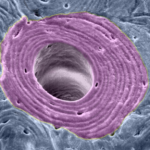
Cortical bone is also called compact bone or lamellar bone.

Shaft of bone in a long bone like femur is typical example of the cortical bone.

Cortical bone forms the cortex, or outer shell, of most bones.  It is much denser than cancellous bone,  harder, stronger and stiffer. Cortical bone contributes about 80% of the weight of a human skeleton. [Read more...]

Hand Injuries – Few Common Terms Used In Relation To Hand

Hand is a complex organ and is injured quite often. In this article we would discuss some common terms in relation to hand injuries and anatomy.

Hand, like foot contains five digits which articulate with respective metacarpals, again five in number.

Names

The digits by their standard name are

  • Thumb
  • Index finger
  • Long or middle finger
  • Ring finger
  • Little finger

Each digit and metacarpal constitute a ray with thumb being part of first ray and little finger that of fifth ray [Read more...]

Guyon Canal or Ulnar Canal

The ulnar canal or Guyon’s canal, is a space at the wrist between the pisiform bone and the hamate bone through which the ulnar artery and the ulnar nerve travel into the hand.

Guyon’s canal is approximately 4 cm long.

It begins at  proximal extent of transverse carpal ligament and ends at the aponeurotic arch of hypothenar muscles. [Read more...]

What is Anatomical Snuffbox?

The anatomical snuffbox is a triangular deepening on  dorsoradial aspect of the hand at the level of the carpal bones. [See image below]

The name originates from use of this space  for snuffing tobacco powder.

.

Anatomical Snuffbox

Anatomical Snuffbox

Anatomically, the tendon of  extensor pollicis longus forms the posterior border

Anterior border is formed by extensor pollicis brevis and the abductor pollicis longus.

The styloid process of the radius forms proximal border and the apex of the triangle formed by anterior and posterior border. [Read more...]

Scaphoid Bone – Anatomy, Biomechanics and Mechanism of Fracture

Fractures of the scaphoid make about 50% to 80% of carpal injuries and occur in young, active individuals. The position of the scaphoid on the radial side of the wrist, as the proximal extension of the thumb ray, makes it vulnerable to injury.

The peak incidence of scaphoid fractures occur in the second and third decades of life.

Anatomy of The scaphoid

Biomechanics of Scaphoid Bone

Intrinsic ligaments  that attach scaphoid  the lunate and distally to the trapezium and trapezoid stabilize the scaphoid.

These ligaments restrict the motion permitting a degree of rotation proximally and a degree of gliding distally .

The scaphoid acts as a link across the midcarpal joint, connecting the proximal and distal carpal rows.

Any shear strain that occurs across the midcarpal joint is transferred through the scaphoid, and may cause fractures and dislocations.

The scaphoid also serves to coordinate and smooth the motions of the proximal and distal rows.

An unstable scaphoid fracture results in  a dissociation of the proximal and distal carpal rows and tendency to collapse.

Mechanism of Fractures

Most of the patients have this fracture following fall on outstretched hand (FOOSH).  These fractures are common in young men  following falls, athletic injuries or motor vehicle accidents.

There is a bending and compression forces on dorsal aspect whereas on palmar surface there are tensile forces. [Read more...]